Frost and Ice Crystals: Winter Macro in the British Countryside
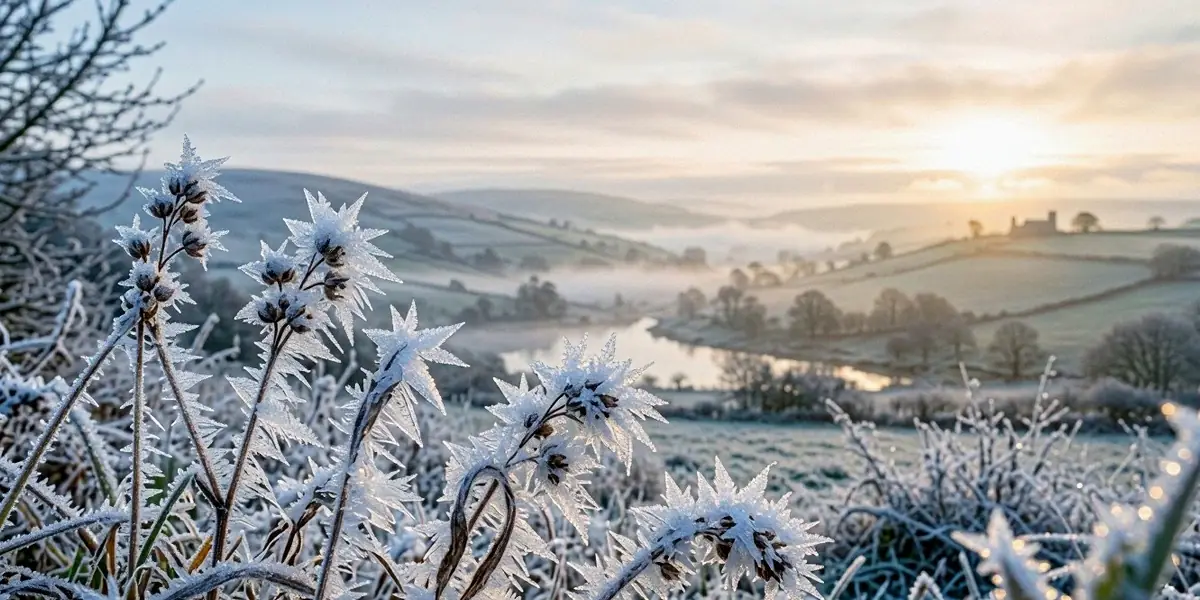
The sun is barely over the ridge and the field beside us is white, but not with snow. Every grass stem, every fence rail and every dead seed head carries a thin crust of frost, and when we kneel down and look through a macro lens, that crust turns out to be a forest of ice needles, plates and columns, each one catching the low light like cut glass. Most people walk past this on the way to work and see nothing but a cold morning. Winter macro photography is how we slow that moment down and photograph structures that exist for maybe forty minutes before the sun erases them.
Why Winter Macro Photography Is Worth the Cold
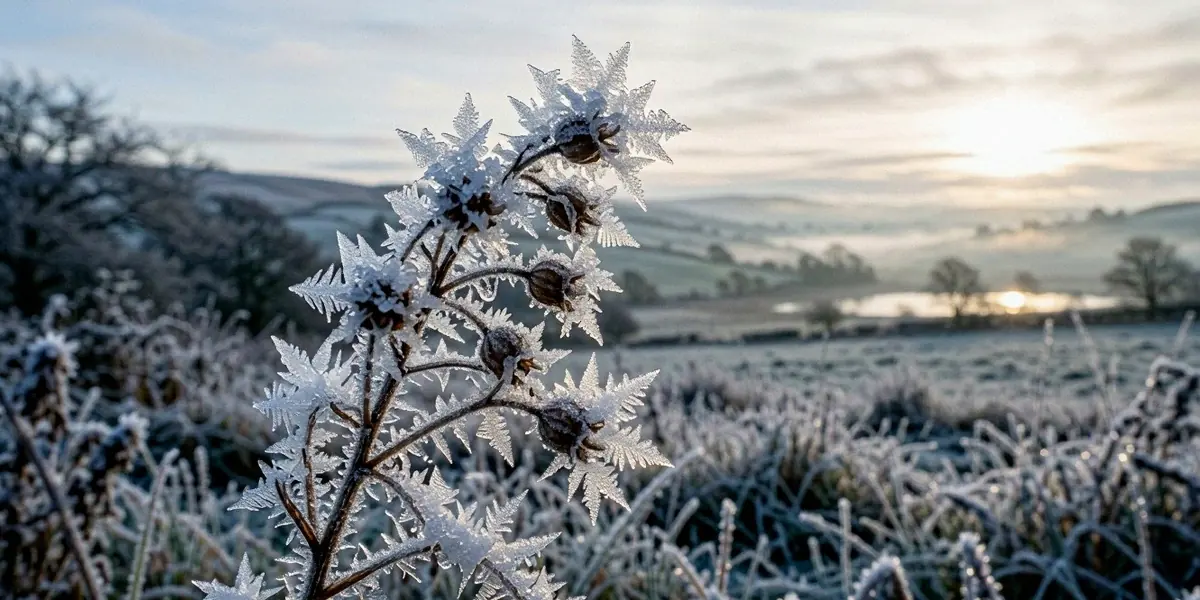
Frost is one of the most generous subjects a close-up photographer can ask for, because it appears on things that are already interesting: the veins of a fallen leaf, the ribs of a teasel head, the strands of an old spider web. Unlike a studio subject, it changes constantly with temperature, humidity and wind, so no two mornings give you the same images. British winters suit this perfectly. Our climate delivers frequent clear, cold nights followed by still dawns, and because our frosts are usually light rather than deep, the crystals stay delicate and photogenic instead of turning into a solid white blanket.
How Frost and Ice Crystals Form
On a clear night, surfaces lose heat rapidly by radiation and can drop below the dew point even when the official air temperature is a couple of degrees above freezing. Water vapour then skips the liquid stage and deposits directly onto those surfaces as ice, a process called deposition. The shape that results depends on temperature and humidity. Around 0°C to −4°C you tend to get simple needles and thin plates; between roughly −5°C and −10°C you get the feathery, branched forms known as fern frost or window frost; below about −15°C, which we rarely see in most of the UK, you start to get hollow columns and cups. That is why a frost on a Cotswold stone wall looks different from one on a Scottish loch shore.
Best UK Conditions for Winter Macro
We plan winter macro sessions around three things: a clear night, a light or absent breeze, and an early start. Still air matters more than temperature, because even a gentle breeze moves a frost-covered seed head by several millimetres, which is fatal at 2:1 magnification. Dawn light is ideal, both for the warm low-angle colour and because the crystals have had all night to grow. Sheltered spots hold frost longer than exposed ones, so we look for the north side of hedges, shaded field edges and valley bottoms where cold air pools.
Essential Macro Gear for Frost and Ice Crystals
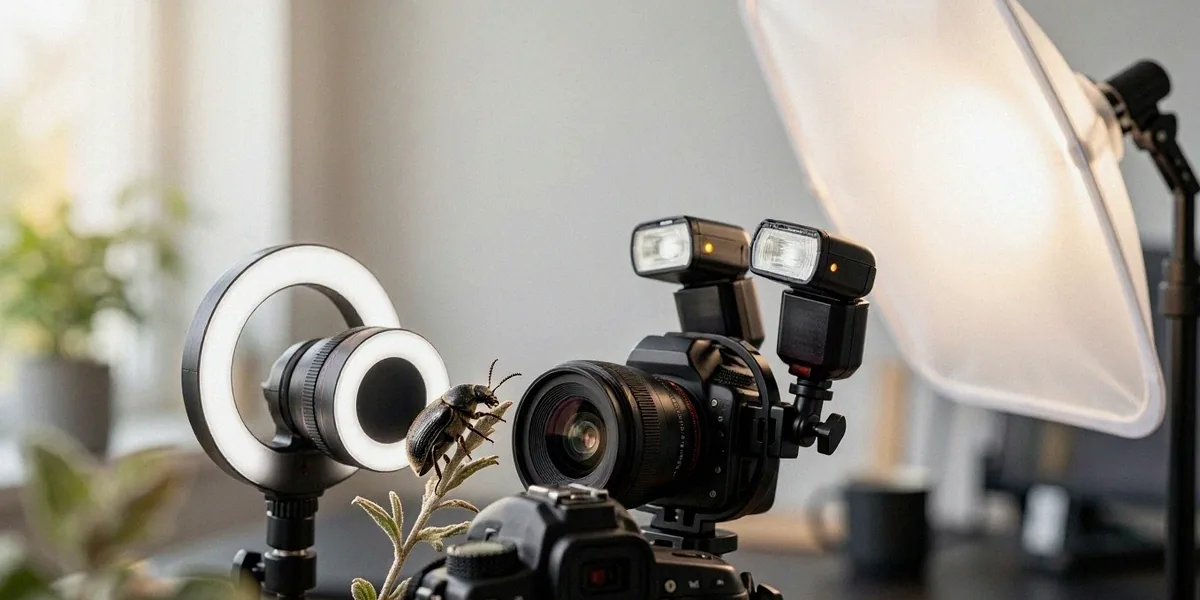
You do not need exotic equipment for this, but a few items make a genuine difference. The core of our winter kit is a dedicated macro lens, a solid tripod, a remote release and a diffused flash. Everything else is optional.
Choosing a Macro Lens for Winter
A true macro lens that reaches 1:1 magnification is the best starting point. On APS-C bodies, a 60mm or 90mm macro is light and easy to carry in cold weather, while a 100mm or 105mm macro gives more working distance, which matters when you are leaning over frosty ground and do not want your own breath melting the subject. Longer focal lengths also make it easier to keep your shadow out of the frame. If you already own a macro lens, winter is the season to learn it properly, because frost rewards precision.
Using the Raynox DCR-250 for Ice Crystals
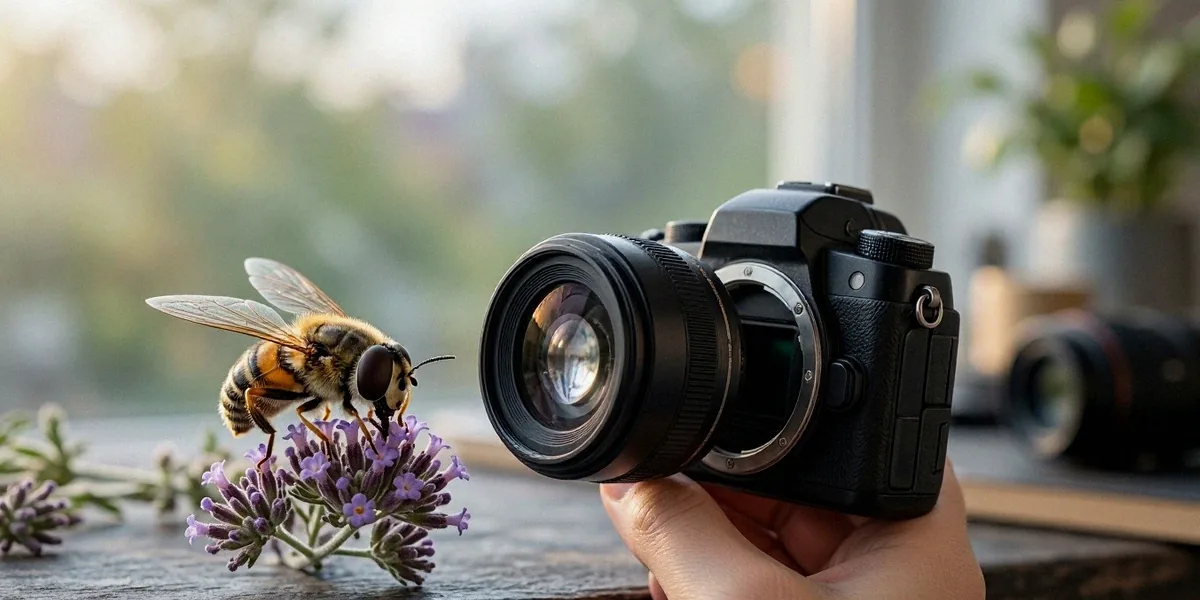
For the smallest structures, we screw the Raynox DCR-250 close-up dioptre onto the front of a telephoto or macro lens. It clips into a universal adapter and pushes magnification well beyond 1:1, which is exactly what you need for individual ice needles and the fine hairs on a frozen seed head. The trade-offs are a very shallow depth of field and a short working distance, so we use it on a tripod with the lens stopped down and usually combine several frames. The Raynox DCR-250 is inexpensive, weighs almost nothing and lives in a coat pocket, which makes it ideal for a frosty morning when you are not sure what you will find.
Support and Lighting in Freezing Conditions
Metal tripods get painfully cold, so we wrap the legs with foam pipe insulation or use a carbon-fibre model with leg warmers. A remote release or a two-second timer removes the last of the vibration. For light, a small flash with a diffuser keeps colour neutral and freezes any residual movement, and it lets you shoot at f/11 or f/16 without a long exposure. Keep spare batteries in an inside pocket; lithium cells lose capacity quickly at low temperatures.
Field Techniques for Sharp Ice Crystal Images
Technique is where winter macro photography is won or lost. The crystals are small, the depth of field is measured in fractions of a millimetre, and your own body heat is the enemy.
Focusing on Tiny Ice Crystals
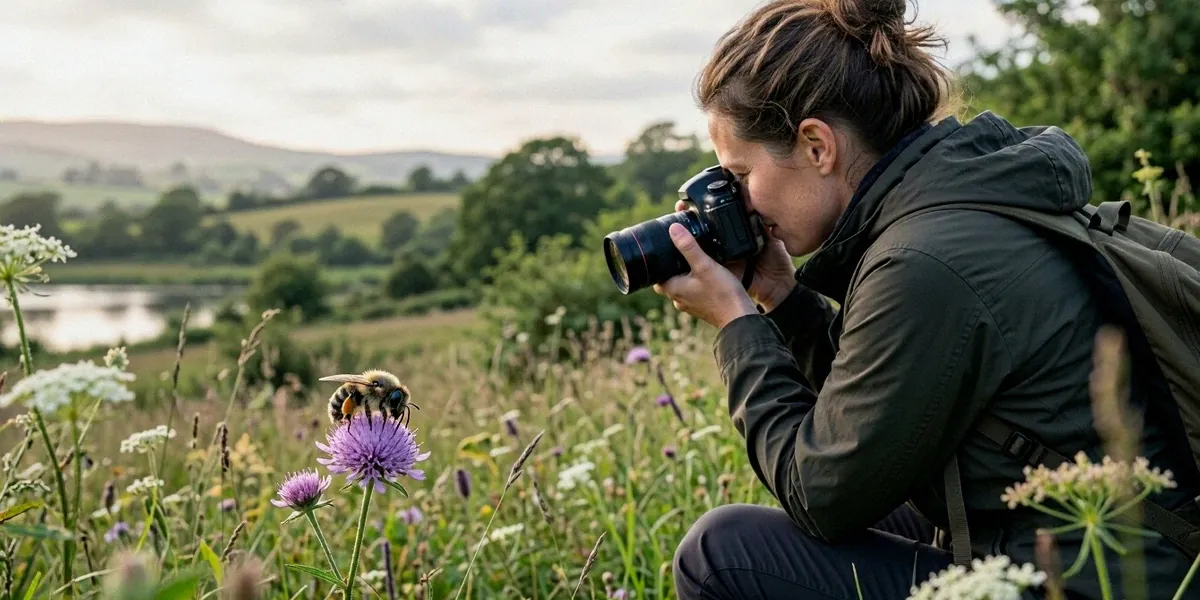
We switch to manual focus and use live view at maximum magnification. Autofocus hunts badly on transparent, low-contrast ice. The most reliable method is to set the focus roughly, then move the camera slowly forward and back on a focusing rail or by nudging the tripod until the plane of focus lands on the part of the crystal you care about. Breathe through your nose, keep your face back from the subject, and work from the side rather than directly above where possible.
Focus Stacking Frost and Ice
At high magnification, even f/16 will not cover a whole frost branch. Focus stacking solves this: you take a series of frames, each focused slightly further into the subject, then merge them in software. On a still morning we will shoot anywhere from six to thirty frames for a single image. A focusing rail makes the increments even, but you can also stack by turning the focus ring in small steps. The result is a frost structure that is sharp from the nearest needle to the far edge, which is impossible in a single frame.
Protecting Your Gear from Condensation
The biggest killer of a winter session is condensation. If you bring a cold camera into a warm house or car, moisture forms on the lens elements, the sensor and inside the body. We seal the camera in a plastic bag before going indoors and let it reach room temperature slowly, which can take an hour. In the field, a microfibre cloth and a rocket blower handle frost that settles on the front element. Never breathe on a cold lens to clear it.
Best British Locations and Subjects for Winter Macro
Frost is widespread, but some places consistently deliver. High ground and sheltered valleys give the coldest nights and the most dramatic crystals.
Countryside Spots for Frost Macro
- The Peak District: gritstone edges, moorland grasses and frost hollows around Bakewell and Hathersage give reliable early-morning frost from November to March.
- The Cotswolds: dry-stone walls, ironstone and old hedgerows hold frost beautifully, and the rolling valleys trap cold air overnight.
- Scottish lochs: shores around Loch Lomond and the Trossachs offer reeds, stones and ice edges, often with mist for atmosphere.
- Local nature reserves: any wetland or meadow with seed heads and unmanaged edges will do if you get there before sunrise.
Common Winter Subjects That Work
We look for frozen seed heads such as teasel, hogweed and thistle; spider webs picked out in white; holly and ivy leaves with rimed edges; and ice on puddles, where trapped air bubbles and cracks make abstract patterns. Frozen moss and lichen on stone are also excellent, because the texture holds crystals well and the background is naturally dark.
Editing and Sharing Your Winter Macro Shots
Winter files usually need less editing than you expect, but a little care with tone and contrast goes a long way.
Basic Editing for Frost and Ice
We start by setting a neutral white balance, since frost picks up colour from the sky and can look blue or magenta. Then we lift the shadows slightly, protect the highlights so the brightest crystals do not clip, and add a touch of clarity or local contrast to bring out the structure. Avoid heavy saturation; the appeal of frost is its restraint. For stacked images, we run the frames through dedicated focus stacking software such as Helicon Focus or Zerene Stacker, then finish the merged file in our usual editor.
Sharing with the UK Macro Community
There is a strong UK macro community online, from dedicated photography forums to regional nature and wildlife groups. Posting a frost series with details of your lens, magnification and stacking settings usually gets useful feedback, and local camera clubs often run winter close-up themes. Sharing location notes responsibly matters too, especially on sensitive sites.
FAQ
What is the best time of day for frost macro photography?
The first thirty to sixty minutes after sunrise. The light is low and warm, the air is usually still, and the crystals have had all night to grow before the sun melts them.
Do I need a macro lens, or will extension tubes do?
Extension tubes work well and are cheaper, but a dedicated macro lens gives better sharpness, flat field performance and easier handling. If you are serious about frost and ice, a macro lens is the better long-term investment.
Is the Raynox DCR-250 hard to use on ice crystals?
It is demanding because depth of field becomes extremely shallow, but with a tripod, manual focus and focus stacking it produces images that are difficult to match any other way at this price.
How do I stop my breath from melting the frost?
Work from the side, keep your face back from the subject, breathe through your nose and shoot quickly. A remote release lets you step away from the camera entirely during the exposure.
Can I focus stack handheld in winter?
Occasionally, in very still air with a fast burst and a steady stance, but the keeper rate is low. A tripod and a focusing rail are far more reliable for frost and ice.
Winter macro photography in the British countryside rewards patience, warm layers and a willingness to experiment with macro lenses, the Raynox DCR-250 and focus stacking. The season looks barren from a distance, but a few centimetres above a frozen leaf there is an entire architecture of ice waiting for anyone prepared to get cold, get low and get close.


Post Comment
You must be logged in to post a comment.